

Many times, I’ve come across people asking: Can I use OPay to buy Bitcoin? It’s a fair question, and I understand why people ask it.
OPay is everywhere in Nigeria. As of 2025, the digital bank has over 50 million users, more than 560,000 agents nationwide, and billions of naira processed every month. If I can pay for DSTV, send money to my mum, and buy data all from one app, why can’t I buy Bitcoin there too?
The short answer is no: you can’t buy Bitcoin directly on OPay. But that’s not the end of the story. There’s a way to use your OPay wallet to buy BTC, and I’ll explain exactly how it works. First, let me explain why OPay itself doesn’t offer crypto and what they’ve actually said about it.
OPay Has Officially Banned Crypto Transactions
This isn’t a rumor I picked up somewhere. In June 2024, OPay Nigeria publicly stated its position on cryptocurrency. The CEO of OPay Nigeria, Mr. Gotring Wuritka Dauda, was direct: OPay has never allowed crypto trading on its platform, and it won’t.
The company said it runs daily scans to detect any cryptocurrency or virtual currency activity on accounts. If your OPay account is found to be involved in crypto transactions, it’ll be closed, and your details could be reported to Nigerian regulators.
“For absolute clarity, OPay has never condoned, nor will it permit, the trading of cryptocurrency or virtual assets on its platform.” – Gotring Wuritka Dauda, CEO, OPay Nigeria (June 2024)
I know that sounds harsh, but it’s not unique to OPay. This statement came shortly after the Central Bank of Nigeria (CBN) tightened its KYC audits on fintechs. OPay is CBN-licensed and NDIC-insured, so it’s only natural that they follow the CBN’s direction closely.
So if you try to use your OPay wallet to pay someone on a crypto platform, or if you receive naira from selling crypto into your OPay account, you’re risking your account. I want to be upfront with you about that before we go any further.
How Are Nigerians Buying BTC with OPay?
Here’s where it gets interesting, and this is what I’ve seen people actually doing. Even though OPay itself doesn’t support crypto, your OPay wallet can still be used as a payment method on P2P (peer-to-peer) crypto platforms. That’s how it works.
P2P trading means you’re buying Bitcoin directly from another person, not from an exchange’s own reserve. The exchange acts as a middleman, locking the seller’s Bitcoin in escrow until the seller confirms you’ve sent your naira. You pay the seller through whatever method they accept, and plenty of P2P sellers in Nigeria accept OPay transfers.
Think of it this way: OPay is just the tool you use to move naira from your wallet to the seller’s account. The crypto exchange handles the Bitcoin side. OPay doesn’t see any crypto: the bank only sees a naira transfer between two of its users.
Important: Even though this method works, it still carries risk. If OPay’s system detects that your transfers are linked to crypto activity, say, through payment patterns to known crypto accounts, they can still flag and close your account. Use this method knowing that risk exists.
Step-by-Step: How to Buy BTC Using OPay as Payment
Let me walk you through how to buy Bitcoin using OPay:
Step 1: Choose a P2P Exchange That Accepts OPay
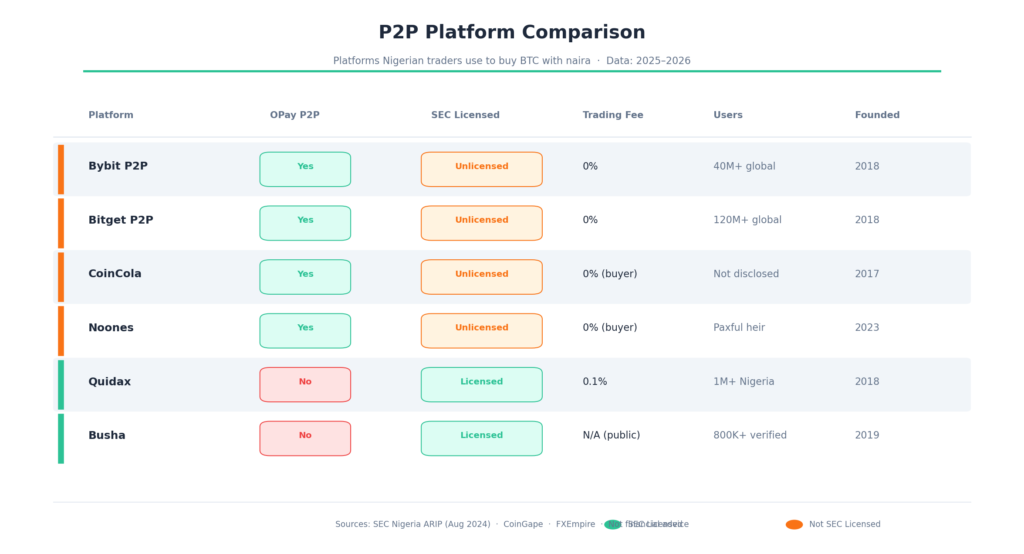
Not every platform supports OPay, so you’ll need to pick the right one. From what I’ve seen, these are the platforms where Nigerian P2P sellers commonly accept OPay transfers:
| Platform | Description |
| ByBit P2P | One of the largest globally, with active Nigerian traders who list OPay alongside bank transfers and PalmPay |
| Bitget P2P | A well-known P2P Bitcoin marketplace that’s supported OPay payments from Nigerian traders for years |
| CoinCola | A Hong Kong-based OTC platform popular in Nigeria that explicitly supports OPay for buying and selling Bitcoin |
| Noones | A newer P2P platform that grew significantly after Paxful paused operations in 2023, and it supports many Nigerian payment methods, including OPay |
Always confirm that the specific seller you’re trading with accepts OPay before you start a trade. Payment options can vary from seller to seller.
Step 2: Create and Verify Your Account
Sign up on whichever platform you choose. You’ll need your email address, a strong password, and identity verification: usually a government-issued ID, such as your NIN slip, voter’s card, or international passport. This is standard KYC practice. It’s now required by Nigeria’s SEC for all Virtual Asset Service Providers under the Investments and Securities Act, signed in March 2025.
Verification usually takes a few minutes to 24 hours. Don’t skip it, as unverified accounts usually come with very low trading limits. Some platforms won’t let you trade at all without it.
Step 3: Filter Offers by Payment Method
Once you’re in, go to the P2P section and filter by offers by selecting OPay as your payment method and Nigerian Naira (NGN) as your currency. You’ll see a list of sellers offering BTC, each with their own rate, minimum trade amount, and trade terms.
The price will usually be slightly above market rate, which I consider normal for P2P. It’s because the seller is taking on the risk of accepting a naira transfer, and that premium is how they manage it.
Step 4: Review the Seller Before You Trade
Check the seller’s completion rate (should be above 90%), their number of completed trades (higher means more trustworthy), and any reviews left by previous buyers. Don’t rush this part, because I’ve seen people skip it and regret it.
A seller with 500 completed trades and a 98% completion rate is far safer than someone with 10 trades and no reviews. Also, read the trade terms carefully to know what to expect. In my experience, some sellers have strict time limits or specific instructions for sending payment.
Step 5: Start the Trade and Transfer Naira via OPay
Enter the naira amount you want to spend (or the BTC amount you want to receive) and start the trade. The platform will lock the seller’s Bitcoin in escrow to protect you. If the seller disappears or refuses to release the BTC after you’ve paid, the platform’s dispute team can release it to you based on your proof of payment.
Once the trade starts, you’ll see the seller’s OPay number or account details. Transfer the naira from your OPay wallet, then mark the trade as paid. Don’t close the chat window. Wait for the seller to confirm receipt and release the Bitcoin to your wallet on the exchange.
Step 6: Move Your Bitcoin to a Safe Wallet
After the Bitcoin lands in your exchange crypto wallet, don’t just leave it sitting there. I don’t do that, especially if it’s a significant amount. Exchange wallets are custodial, meaning the company holds your private keys. If the exchange is hacked, goes under, or freezes withdrawals, your BTC could be stuck.
For amounts beyond a small trade, I’d recommend withdrawing to your own wallet. MetaMask doesn’t support BTC, so use a Bitcoin-compatible wallet like Trust Wallet, Electrum, or a hardware wallet like Ledger Nano X. Phantom can even work.
What’s It Going to Cost You? Understanding Fees
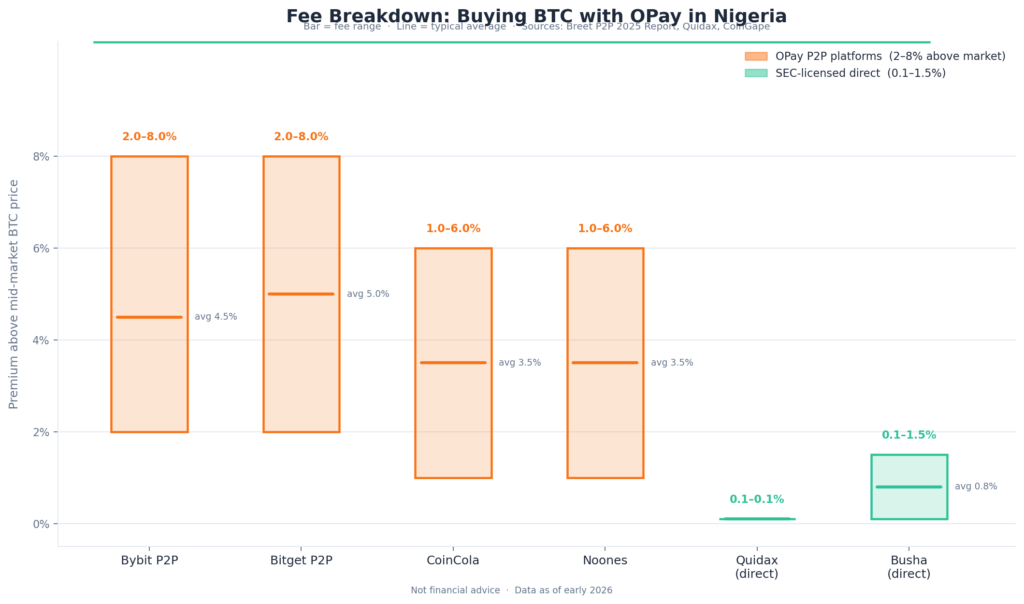
When buying BTC with OPay through P2P, there are two main costs I advise accounting for:
- P2P Premium: The price sellers charge on P2P is typically 2% to 8% above Bitcoin’s real market price. This varies by platform and how competitive the marketplace is at that moment. I usually check rates on two or three platforms before committing.
- OPay Transfer Fee: Transfers between OPay users within the app are usually free. If you’re sending from OPay to a bank account instead, there may be a small charge.
The P2P platform itself generally doesn’t charge the buyer a trading fee. Instead, it makes money from the seller’s side. That makes P2P one of the more affordable ways to buy BTC in Nigeria compared to centralized exchanges that charge a trading fee on top of the spread.
SEC-Licensed Platforms Worth Knowing About
Since March 2025, Nigeria’s crypto market has become more structured. The Investments and Securities Act 2025 brought all Virtual Asset Service Providers under the supervision of the Securities and Exchange Commission (SEC). Exchanges that want to operate legally in Nigeria now need SEC registration.
Two local platforms that received provisional Digital Assets Exchange licenses are Quidax and Busha. On both, you can buy Bitcoin with naira through a regular bank transfer. It’s not OPay specifically, but a linked Nigerian bank account.
If regulatory compliance matters to you (and I’d argue it should), these are the cleaner long-term options. For P2P platforms like Bitget and Paxful, I suggest checking their current licensing status with the Nigerian SEC before moving large amounts. The regulatory rules are still shifting, and it’s worth staying current.
Risks to Know About Before You Start
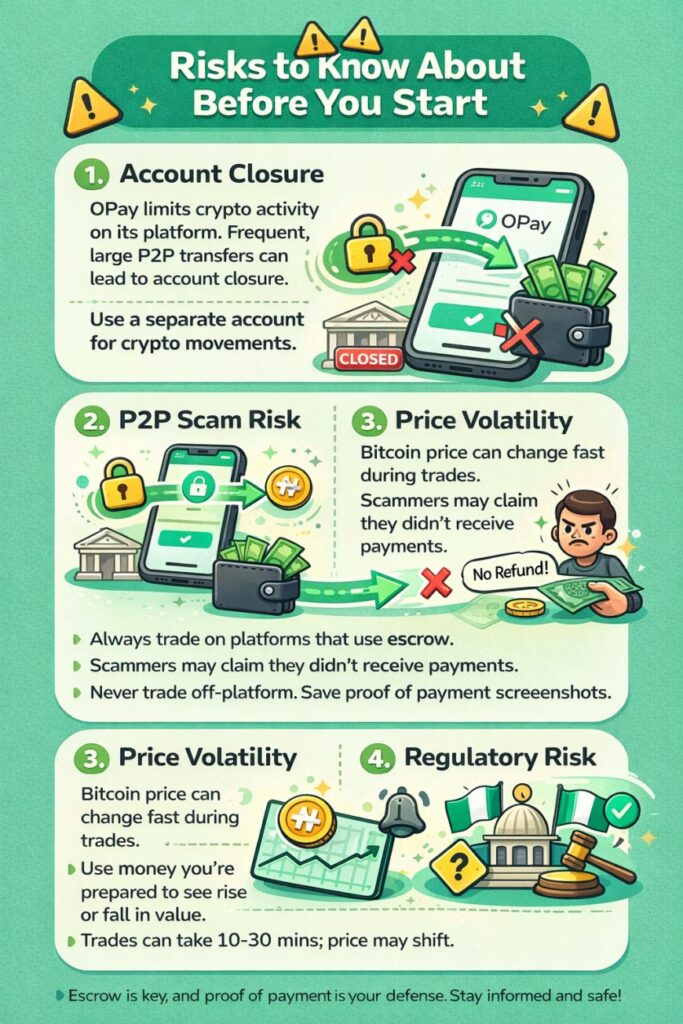
I won’t pretend this is completely without risk. Here’s what I think you should understand clearly:
Account Closure
As I mentioned earlier, OPay actively monitors for crypto-related activity. If your OPay account gets flagged, say, for frequent, round-number transfers to the same accounts linked to crypto trading, it could be closed. This has happened to Nigerian users; it’s not theoretical.
The safest approach I’ve seen is to keep your volume moderate and not use OPay as your main account for heavy crypto trading. Some experienced traders keep a separate account specifically for P2P naira movements.
P2P Scam Risk
The most common P2P scam I’ve heard about goes like this: you transfer naira to the seller, they claim they didn’t receive it, and then they try to drag out the trade or cancel it. This is exactly why it’s critical to only trade on platforms with escrow. The BTC must be locked before you ever send any money.
Never trade off-platform. If someone asks you to “just send the OPay” before starting a formal trade on the platform, that’s your cue to walk away. Always save your proof of payment (OPay receipt screenshot) for every single trade.
Price Volatility
Bitcoin’s price moves quickly. Between the time you start a trade and when it’s completed, which can take 10 to 30 minutes, the price can shift. That’s not a platform issue, as it’s just how Bitcoin works. I always remind myself to only put in money I’m comfortable seeing go up or down in value.
Regulatory Risk
Nigeria’s crypto rules changed significantly in 2023, 2024, and again in 2025 with the ISA. They can change again. Using P2P with OPay sits in a grey area since OPay prohibits it, and depending on how the SEC’s framework develops, the activity could attract more scrutiny. I stay up to date on CBN and SEC announcements, and I’d encourage you to do the same.
Alternatives That Are Cleaner Than OPay P2P
If the OPay risk feels too high for your situation, here are options I’d point you toward instead:
- Quidax (quidax.com): SEC-provisionally licensed Nigerian exchange. Deposit naira via bank transfer and buy BTC directly. Regulated and naira-friendly.
- Busha (busha.co): Another SEC-licensed Nigerian platform with a clean interface for buying Bitcoin with naira.
- Yellow Card (yellowcard.io): Pan-African exchange that accepts Nigerian bank transfers. Available across multiple African countries.
Bottom Line
Can you buy BTC with OPay? Yes, but not directly through OPay itself. The platform has made it clear that it won’t allow crypto. But you can use your OPay wallet as the payment method on a P2P platform to buy Bitcoin from another Nigerian? I’ve seen plenty of people in Nigeria do exactly that.
The way it works is simple. You go through a P2P exchange, find a seller who accepts OPay, and transfer your naira directly through the OPay app. The exchange holds the BTC in escrow and releases it to you once the seller confirms your payment.
Don’t forget the risks involved. OPay can close accounts it flags for crypto activity, and P2P trading has its own dangers if you’re not careful. I’d say: use platforms with escrow, take time to vet sellers, save every receipt, and never trade off-platform.
If you want the cleanest option, go through a SEC-licensed Nigerian exchange like Quidax or Busha and fund it with a regular bank transfer. It’s a little slower, but it’s a lot less complicated.
Whatever method you choose, don’t rush. Start small, protect your funds, and learn as you go. Bitcoin isn’t going anywhere, and neither is your chance to be part of it.