

We’ve seen different comments on crypto Twitter about Web3 gaming. Some say it’s the future, while others say it’s just another way to lose money. Who’s right and who’s wrong? Well, we’re here to explain, so you can decide for yourself.
The global Web3 gaming market was valued at $31.49 billion in 2024 and is expected to reach $182.98 billion by 2034. Any way you look at it, that’s not a small number.
Nigeria is already accounting for 26.5% of Africa’s gaming revenue, generating $300 million in 2024. As a result, it’s understandable why many people are interested in the industry. Read on as we explain what you need to know.
What is Web3 Gaming?
Simply put, Web3 gaming is form of gaming that uses blockchain technology.
In a regular game like FIFA or Call of Duty, anything you buy or earn stays within the game. You can pay for a skin, win a weapon, or grind for a rare item, but none of it really belongs to you. Instead, the game company owns it, and if they shut down the servers tomorrow, everything’s gone.
The entire system changes with Web3 technologies. If you earn or buy an item in a Web3 game, it’s recorded on the blockchain as a digital asset. Most of the time, it’s an NFT that you actually own. You can sell the item, trade it, or transfer it to another game, and no company can take it from you.
How Web3 Games Work
Every Web3 game runs on smart contracts. To clarify, smart contracts are codes on the blockchain that automatically enforce the game rules. In other words, there’s no need for a middleman or a company to change things.
Based on our experience, these are the main aspects of how Web3 games work:
- NFTs: Your in-game items, including characters, weapons, land, and skins, exist as NFTs on the blockchain. You own them and can trade them on open marketplaces.
- Tokens: Most Web3 games have their own crypto token, which you earn by playing. You’re allowed to convert it to real money (e.g., USDT) or sell it for naira via an exchange.
- Play-to-Earn (P2E): Instead of just playing for fun, you receive crypto rewards for completing quests and winning battles. At the same time, you’re contributing to the game world.
- Decentralized Platforms: Web3 games run on blockchain networks, not on a single company’s server. Therefore, there’s less censorship and more transparency.
Popular Web3 Gaming Platforms and Sites
At this point, we’re sure you understand the basics of Web3 gaming. Now, let’s go into the top platforms to try in Nigeria:
1. World of Dypians
This is a multiplayer RPG built on BNB Chain. DappRadar ranked it the #1 Web3 game in Q3 2025, with 135 million active wallets and over 390 million on-chain transactions. It launched on the Epic Games Store, making it one of the first Web3 games to enter mainstream gaming storefronts.
2. Axie Infinity
Here’s the game that introduced millions to play-to-earn, including in Nigeria. It’s pretty simple, as you collect and battle creatures called Axies. That said, its developer, Sky Mavis, is now building it into a bigger gaming model for 2026.
3. The Sandbox
Are you familiar with Minecraft? If so, The Sandbox is exactly like that, except that it runs on the blockchain. You can buy virtual land, build on it, and sell it. In our research, we confirmed that major brands such as Snoop Dogg and Adidas have purchased land in The Sandbox metaverse.
4. Decentraland
In Decentraland, you step into a virtual world where you can buy land as NFTs and host events. You can also build games and earn tokens, so it’s more of a virtual economy than a traditional game. Anyway, it’s one of the oldest and most active Web3 gaming platforms.
5. Gala Games
This platform hosts multiple games across different genres, including strategy, RPG, and card games. The GALA token powers all of them, and it’s one of the few Web3 gaming sites with a wide library.
6. Telegram-Based Games (Notcoin, Hamster Kombat)
These options became popular in Nigeria specifically because they require nothing but a Telegram account and a smartphone. A popular title, Hamster Kombat, had 300 million players globally at its peak. The earnings model is also simpler, as it involves tapping, accumulating tokens, and waiting for listings to appear.
Web3 Gaming Risks You Should Know About
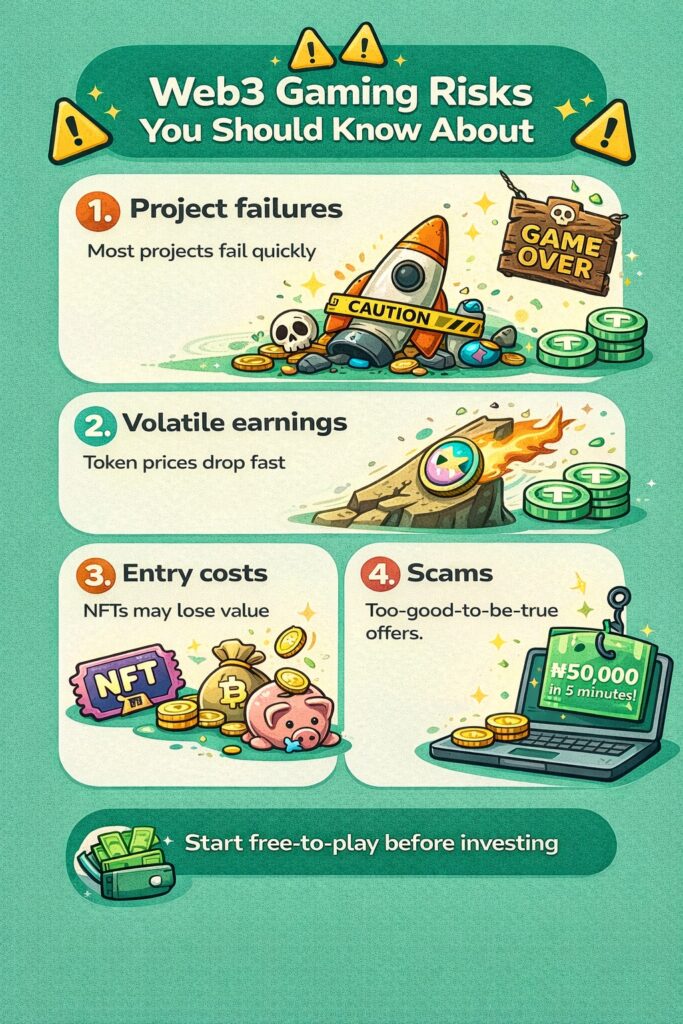
We’d be doing you a disservice if we only talked about the upside. Web3 gaming has real risks, including:
- Project failures: DappRadar’s 2024 Games Report found that 93% of blockchain gaming projects fail within their first year. Most games launch with a lot of hype and a broken economy.
- Volatile earnings: The tokens you earn can crash overnight. To illustrate, Axie’s SLP token dropped over 90% from its peak. As a result, we advise always converting some earnings to stable assets like USDT.
- Entry costs: Some games require you to buy NFTs before you can start earning. If the game dies, those NFTs become worthless.
- Scams: Plenty of games promise “₦50,000 in 5 minutes” and deliver nothing. If it sounds too good to be true, it usually is.
Our rule is not to invest what you can’t afford to lose. Start with free-to-play Web3 games in Nigeria before you put your money in.
Steps to Get Started with Web3 Gaming in Nigeria

You don’t need to be a tech person to start playing Web3 games in Nigeria. Simply follow these steps if you’re new:
- Set up a crypto wallet: MetaMask (for Ethereum-based games) or Phantom (for Solana games) are the most common. Both are free to download.
- Buy some crypto if needed: Use a Nigerian exchange like Bybit P2P, Binance P2P, or Yellow Card to buy USDT with naira. For Telegram games, you’ll need TON.
- Pick a game: Start with free-to-play options. Examples include World of Dypians, some Gala Games titles, and Telegram mini-apps that have no upfront cost.
- Convert and withdraw: When you receive tokens, sell them on an exchange, withdraw naira to your bank, or use USDT to avoid volatility.
What’s Next for Web3 Gaming?
The Web3 gaming industry in Nigeria is growing fast. In April 2025, Ubisoft, one of the world’s biggest game companies, launched Might & Magic: Fates on Immutable’s blockchain. Big Time Studios, whose team includes former Epic Games and Blizzard developers, recorded over $100 million in revenue and $230 million in player transactions in 2024. Clearly, these aren’t startup projects anymore.
Things are changing right now from ‘play-to-earn’ to ‘play-to-own.’ The focus is moving away from just making money to actually having fun while keeping ownership of what you build inside the Web3 game. We consider it a healthier model, and it’s what will make Web3 gaming stick for a long time.
As a Nigerian player, there’s a real opportunity, but it requires patience and education. You can’t just jump in and make a stable income from any Web3 game, but if you learn the ropes, you’ll improve your earnings over time.
Frequently Asked Questions
Can you make money playing Web3 games in Nigeria?
Yes, you can make money playing Web3 games in Nigeria, but it’s not a guarantee. Money often comes from selling in-game NFT assets, earning game tokens, or staking for rewards.
What are the most popular Web3 games?
As of 2026, the most popular Web3 games for Nigerians include World of Dypians, Axie Infinity, The Sandbox, Decentraland, Gala Games titles, and Illuvium. Telegram-based games like Notcoin and Hamster Kombat are also widespread.
How do you become a Web3 game developer?
You can become a Web3 game developer by learning traditional game development and blockchain skills. Programming languages such as JavaScript, Python, Solidity, and Rust are essential. You also need to be familiar with game engines such as Unity or Unreal Engine.